
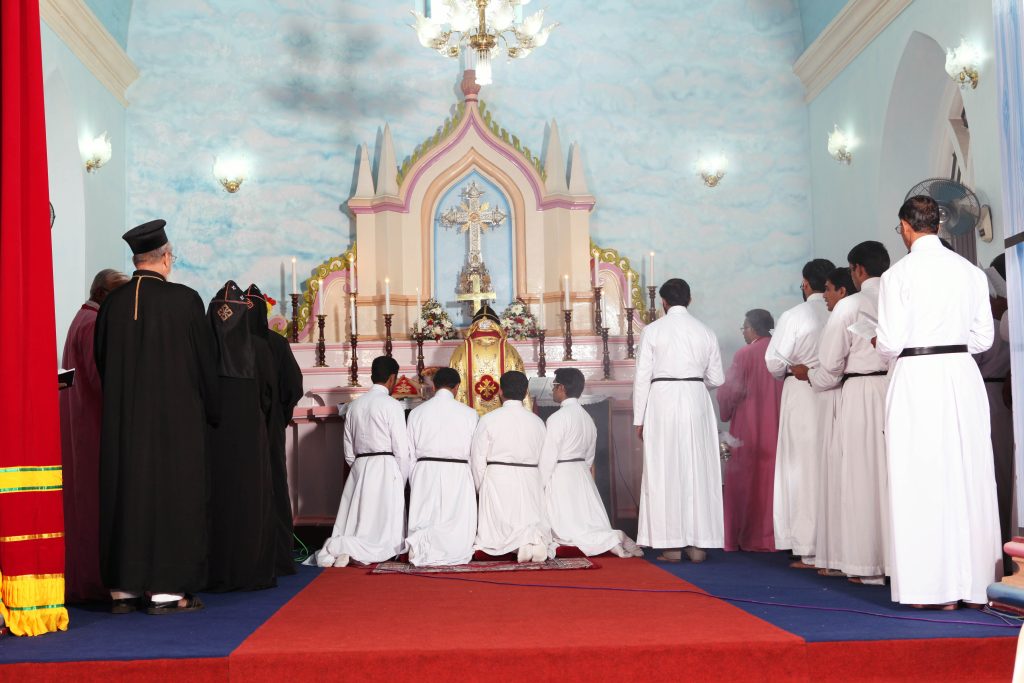
Priesthood of Jesus is an honour given to the church. Since the royal priesthood has been given to the whole church, all the believers are part of the ordained community.(1 Peter 2:9). “It was He who gave some to be apostles, some to be prophets, some to be evangelists, and some to be pastors and teachers” (Ephesians 4:11). The people who have the call for full-time ministry and who have been entrusted with the task by the church conduct priestly service for the church (Heb.7.26-8.1-4).
The Constitution of the Mar Thoma Church defines the Deacon and Priest as :
“ DEACON/SEMMAS
Diaconate stands as the image of the ministry of the people of God, who are called and commissioned to serve in the world. The essence of this office is to be found in various ministries performed by Jesus Christ.
Deacon has the responsibility to assist the minister in celebration of Sacraments and conduct of public worship and to care for the poor and the sick and to protect the helpless.
CLERGY/KASSEESA
Being a steward in the Church, the Clergy has the special responsibility-
- to shepherd the flock in this world,
- to participate ardently in the work of the Kingdom of God, through the ministry of the WORD and celebration of Sacraments,
- to be witnesses in the Church, which is the body of Christ,
- to partake in the spiritual and temporal growth of the Kingdom of God in the name of Christ.
He has responsibility-
- to shepherd God’s flock and render sacrificial service, according to the will of God,
- to be fervent in the proclamation of Gospel and constant in the ministry of teaching,
- to manifest the dignity of Christian ministry, in the Parish and in the Society.
Subject to the direction and control of the Diocesan Episcopa, the Clergy has the special responsibility to celebrate Sacraments, exercise ministry of the Word and perform other ministries and make appropriate arrangements for the same.
The Clergy in charge of a parish, shall make ardent efforts, to advise and correct unrepentant persons living in sin and so also persons who violate the laws of the Church or act in derogation of the interests of the Church, the Diocese or the Parish or recognised institutions of the Church and wherever circumstances so require, bring such lapses to the notice of the Diocesan Bishop, for further action. “
Order of Ordination
Before the ordination, the celebrant reads out the church’s advice called “Amologia” to the candidate. As a mark of acceptance, he makes a sign of the cross on the register. As a symbol of his submission, he bows his head before the celebrant. From the four corners of his head, the hair is being cut in the shape of the cross. Usually, the candidate stays with the celebrant in the church the previous night. During this time, a portion of the hair in the shape of a circle is cut out from his head. It is from the four sides of this circle that hair in the shape of a cross is cut out during the ordination service. It is a symbol of the candidate’s complete submission. Promeon, Sedra, Lessons,Epistle and Gospel reading are part of the service. Special prayers are said for the dwelling of the Holy Spirit. After that, the Bishop declares that the candidate has become a priest. Then the thanks giving prayer is offered. The celebrant raises the candidate by his right hand and give Bible to him. His official dress is blessed and given to him. The new Priest attired in his official dress, and with incense he bows to the congregation. The first priestly action is the offering of the incense. The candidate bows the altar celebrant and the people. Then the Holy Communion service follows.
Important Symbols during Ordination Service
Cutting of hair in the shape of a cross: When the celebrant cuts the hair in the shape of a cross forms the head of the candidate; it symbolizes an end to the past and his total submission for the priestly position.
Putting the Sosappa on the candidate’s head:In the Old Testament, clouds, lightning, smoke, etc. were considered symbols of divine presence. In this sense, Sosappa symbolises God’s presence. It is when prayers are made for the dwelling of the Holy Spirit and when the Gospels read the Sosappa is placed on the candidate’s head. Then the celebrant breathes on the candidate in the shape of a Cross (St. John 20.21).

