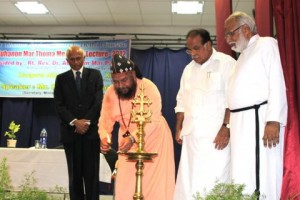
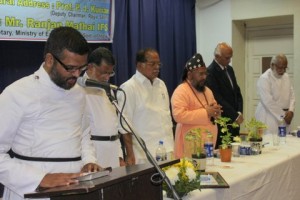
 Juhanon Mar Thoma Lecture was organized by the Delhi diocese of the Mar Thoma Church on 23rd Sept. 2012 at Y W C A Hall, New Delhi. A large gathering from different walks of life attended the meeting which was presided over by the Diocesan Bishop Rt Rev Dr Abraham Mar Paulos. The meeting was inaugurated by Prof. P J Kurian, Deputy Chairperson, Rajya Sabha. Beautiful melodies were rendered by St Thomas, Ebenezer and Ghaziabad choirs. During the meeting the logo of the Christmas programme of the Diocese “Gloria In Excelsis” was also released by His Lordship Mar Paulos. Mr Ranjan Mathai, Secretary, Ministry of external Affairs was the Chief Guest and he spoke widely on the subject “India in the 21st Century: current Trends and Prospects”.
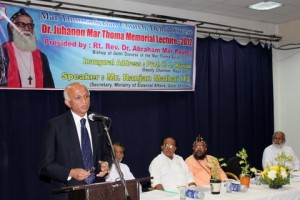
Where will India be a few decades from now? Many, including thinkers, economists, politicians and statisticians, have tried to answer this question. The shorter the period chosen for such a projection, the greater has been the public interest in it. When Foreign Secretary Ranjan Mathai grappled with this question, while delivering the Juhanon Mar Thoma memorial lecture in New Delhi, it, therefore, evoked considerable enthusiasm among the listeners.
Like former President Abdul Kalam, the head of India’s diplomatic establishment chose the year 2020 to make his projections. He had all the figures at his fingertips to establish that India would be the world’s fourth largest economy after China, America and Japan. He narrated how he had to enter the wax museum in Paris through the back door as the police had closed the front door to hold at bay a large crowd of girls who wanted to meet actor Shah Rukh Khan, whose wax statue was being unveiled. “Not one of the girls was an Indian”.
There was also the usual stuff about the exponential growth in the number of mobile phones in India and the single largest number of engineers passing out every year. He also mentioned some imponderables like the explosive situation in the Gulf and the presence of two “un-reconciled” enemies, without identifying them. A wag had once described a diplomat as one who can describe the hell so beautifully that one would try to reach there by the first available flight.
Since he is not just privy to policy-making but is also an active participant, it is difficult to segregate his views into two — personal and official. In fact, it was the official nature of his talk, though delivered to a select gathering, that lent it more importance.
Little surprise, the malaise of our policy-making was clearly reflected in his speech. It is true that the latest figures show that the purchasing power of the rural Indian is now more than that of the urban Indian. However, allowance has to be made for the fact that many poor people in India needlessly spend money on mobile phones – money that should have been spent on food, clothing and education.
It’s true that life expectancy in India is now 65 against 29 when India got independence in 1947. But what is overlooked is that the situation in China was similar, if not worse, but today life expectancy in China is 74. Life expectancy in poorer Bangladesh is now higher than India’s. While China’s growth rate dazzles the Indian establishment, it is not even conscious of its other achievements.
The infant mortality rate is 50 per thousand in India against 17 in China. The rate of death of children under the age of five is 66 per thousand in India against 19 in China. The mother’s mortality rate is 230 (against 100,000 live births) in India against 38 in China. In absolute terms, the number of illiterates in India has increased over the years since Independence. India has more mobile phones than toilets. Even in a city like Delhi, hundreds of thousands of children of migrant workers and slum dwellers grow up without seeing the inside of a school, though the Right to Education Act is in force.
Policy makers believe that once the gross domestic product (GDP) grows substantially, it will have its trickle-down effect and poverty will get eliminated. Alas, poverty elimination has never happened this way. China spends more on public health and education than India. For instance, China spends 2 per cent of its GDP on public health, which is not substantial, but India spends even less — 1.1 per cent. Almost every Chinese has access to a toilet, while India’s case is worse than that of Afghanistan. Before Japan achieved the status as the world’s second largest economy — now replaced by China — it had attained 100 per cent literacy.
India was never a poor country. In fact, it was its famed riches that attracted conquerors and colonists to this country. Where it lagged behind was in using the wealth for the larger good of the people. In other words, only policies which are inclusive and are aimed at lifting the poor and the marginalised from poverty can address the needs of the 21st-century India.
 Unfortunately, such a need is not even felt in the ruling establishment which can think of only ideas like a job guarantee schemes that ensures a $2-per day job per family for a maximum of 120 days a year. The nation needs innovative, out-of-the box ideas to make India a better place to live than to fly away from.
Rev Dr P G George, Principal, welcomed the gathering and Rev C Joseph, the Convener delivered the vote of thanks.


